
Why Sayu A Search Team Built for an AI-Driven Future
People now ask ChatGPT, Gemini, Perplexity and Google’s AI Overviews for recommendations, and those tools answer with a short list of brands and sources.
Our team tracks how these engines choose what to cite, and optimises your website so that your brand is one of them.
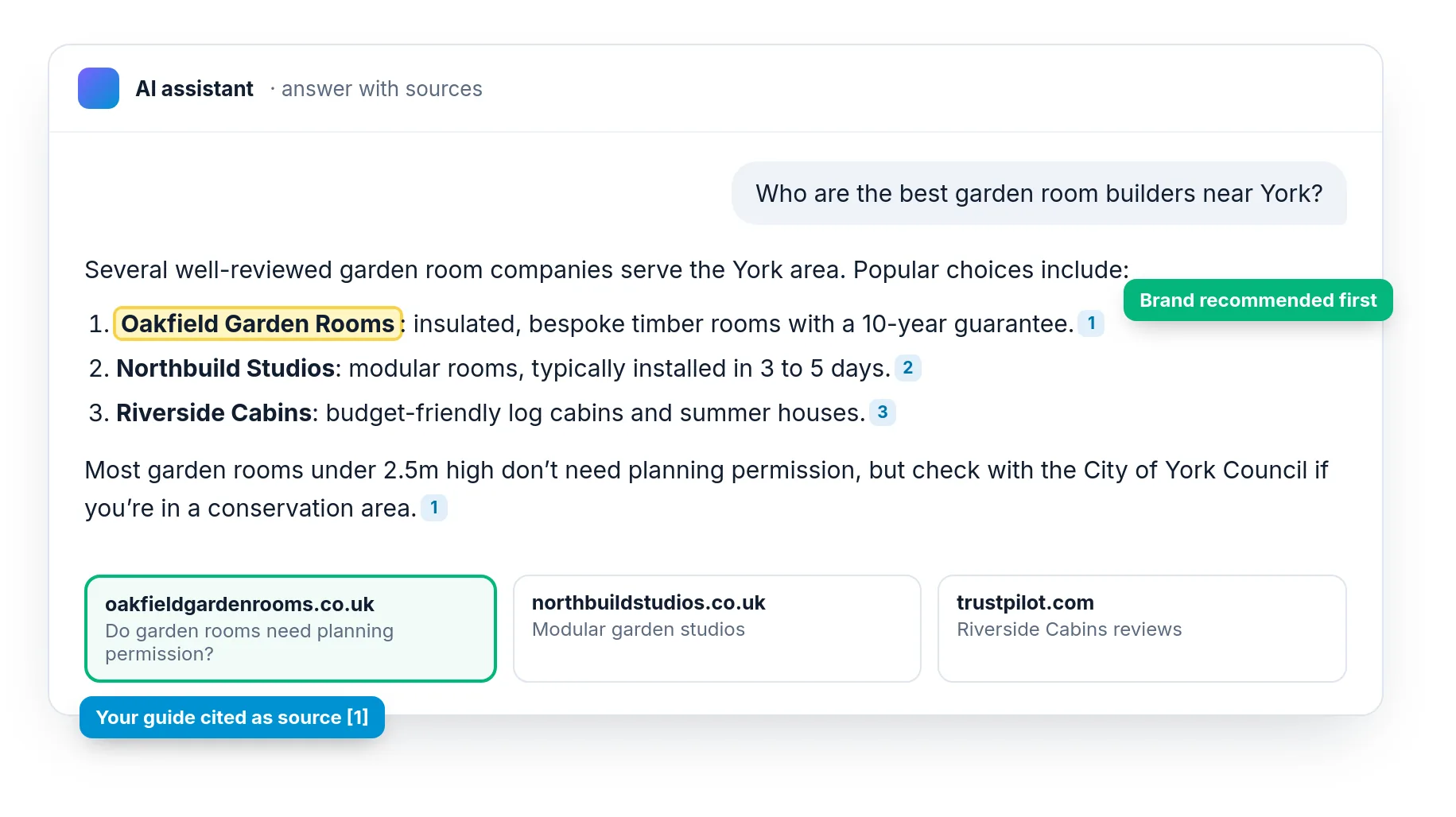
What Being Visible in AI Search Looks Like
When someone asks an AI assistant for a recommendation, there is no page two. The answer names a handful of businesses and links to the pages it relied on. If you are not in that answer, you are invisible to that customer.
Two things count: being mentioned as a recommended brand, and having your content cited as a source. Both come from the same work: clear, trustworthy content on your site and a strong reputation across the web.
Search Is Spreading Across More Places
Google is still the biggest source of search traffic, but AI assistants are growing fast and sending visitors who are often further along in their decision.
Organic vs AI-referral visits
Indexed to 100 at the start, illustrative
- Google organic
- AI referrals
Illustrative trend based on industry reports. AI referrals start from a much smaller base than Google organic.
View the data as a table
| Month | Google organic | AI referrals |
|---|---|---|
| Jan | 100 | 100 |
| Feb | 101 | 118 |
| Mar | 99 | 135 |
| Apr | 102 | 160 |
| May | 103 | 182 |
| Jun | 101 | 210 |
| Jul | 104 | 245 |
| Aug | 105 | 270 |
| Sep | 103 | 310 |
| Oct | 106 | 350 |
| Nov | 107 | 395 |
| Dec | 108 | 440 |
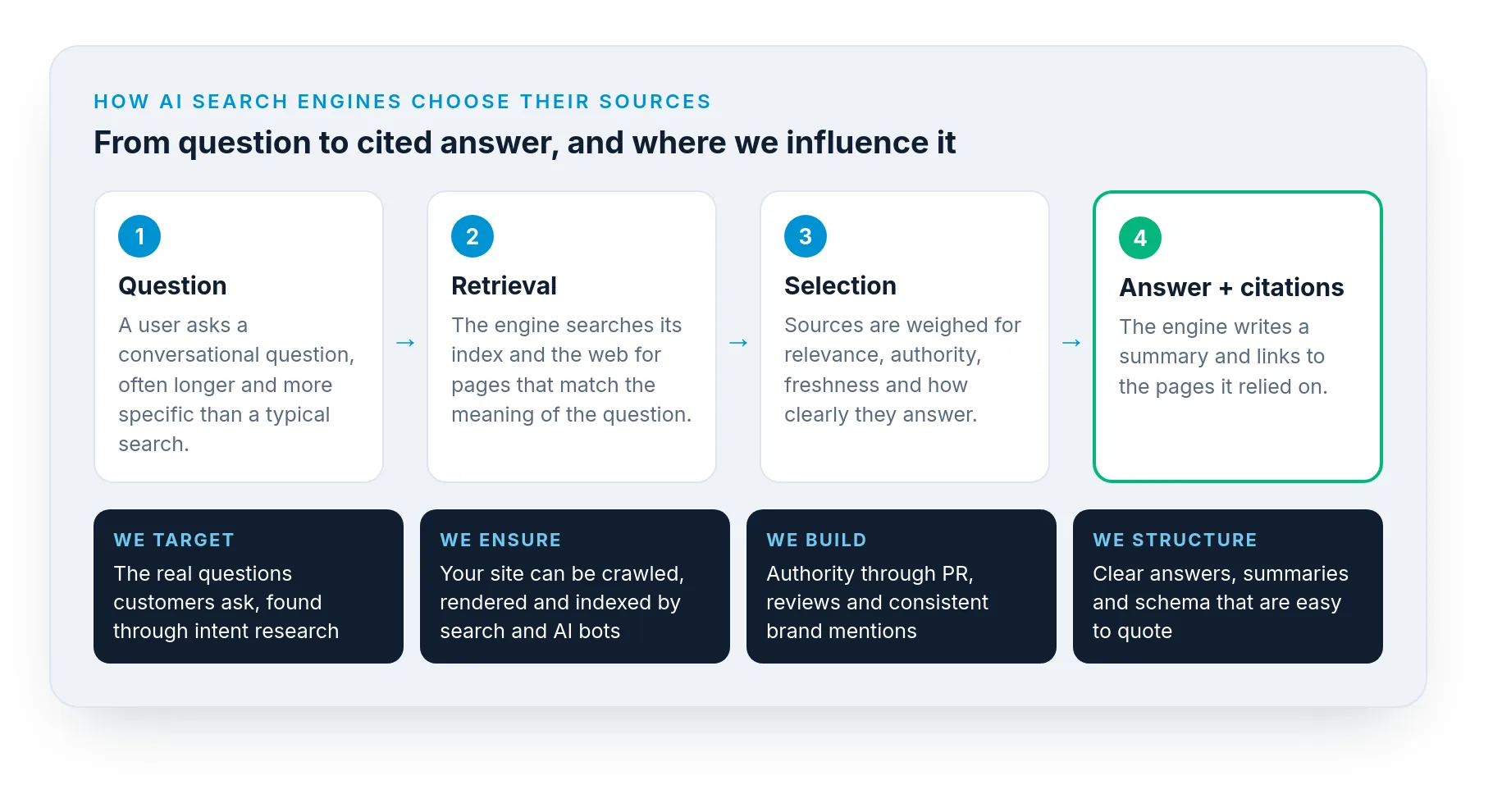
How AI Engines Choose Their Sources
AI search engines do not invent their recommendations. They retrieve pages from the web, weigh them for relevance, authority and clarity, then summarise the best ones and cite them.
That gives us four places to influence the result: the questions you target, whether AI crawlers can read your site, the authority of your brand, and how quotable your content is.
How Our Team Stays Ahead
AI search changes month to month. Keeping up is part of the job, not an extra.
- 01
Monitor
We track Google updates and changes to ChatGPT, Gemini, Perplexity and AI Overviews every week.
- 02
Test
New ideas are tested on our own and partner websites before they reach yours.
- 03
Share
Findings are shared across the team in regular knowledge sessions.
- 04
Apply
Proven tactics are rolled into every client roadmap, with the reasons explained.
What We Optimise for AI Search
Answer-Ready Content
Clear summaries and direct answers to the questions customers actually ask.
Structured Data
Schema markup that tells engines exactly what your business, products and services are.
Crawler Access
Checks that search and AI crawlers can reach, render and read your important pages.
Brand Mentions
Digital PR and reviews that make your brand a name AI engines trust and repeat.
Consistent Business Details
The same name, services and contact details everywhere, so engines are confident about who you are.
AI Visibility Tracking
We monitor how often your brand appears and is cited in AI answers, and report it monthly.
Questions
Not yet. Google still sends most search traffic, and Google itself now shows AI Overviews. The right approach is to optimise for both, and the good news is that most of the work overlaps.
No one can honestly guarantee that, as AI answers vary from one question and one user to the next. What we can do is make your brand a much stronger candidate and measure the change over time.
We track a set of relevant questions across the main AI engines, recording when your brand is mentioned or your pages are cited, alongside AI-referral traffic in your analytics.
Usually not. Well-structured content that answers questions clearly works for Google and AI engines alike. We adapt existing pages first, and add new ones where there are gaps.
More Reasons to Choose Sayu
Proven SEO Expertise, Future-Focused Strategy
Twenty years of SEO fundamentals, applied to how people search today.
Read MoreSustainable, Ethical SEO Practices
Why we refuse shortcuts, and what that means for your rankings.
Read MoreTransparent Collaboration & Clear Communication
Reports, roadmaps and regular calls: you always know what we are doing.
Read MoreTailored SEO & AI-Search Strategies
Why a local plumber and an online shop need very different plans.
Read MoreHigh-Quality Content & Sustainable Authority Building
Content that earns rankings, links and citations, year after year.
Read More